a year in Canterly (Mythic Bastionland play-by-post report)
Shortly after the conclusion of Over/Under - a transformational experience for me within the hobby - all the "cowboys" of the CanyonHeavy Collective were invited to decompress and stay in touch in a Discord server set up by Luke Gearing (who played as one of our incredible faction leaders).
In the hazy game-befuddled stupour of those early post-O/U days, hankering for more good gaming and finding myself suddenly in community with so many cool people, I shot my shot: the Mythic Bastionland Realm I'd been running for myself as a solo game, the one I'd already done all that prep for and expanded through play?
"Hey cowboys... who's up for being a knight?"
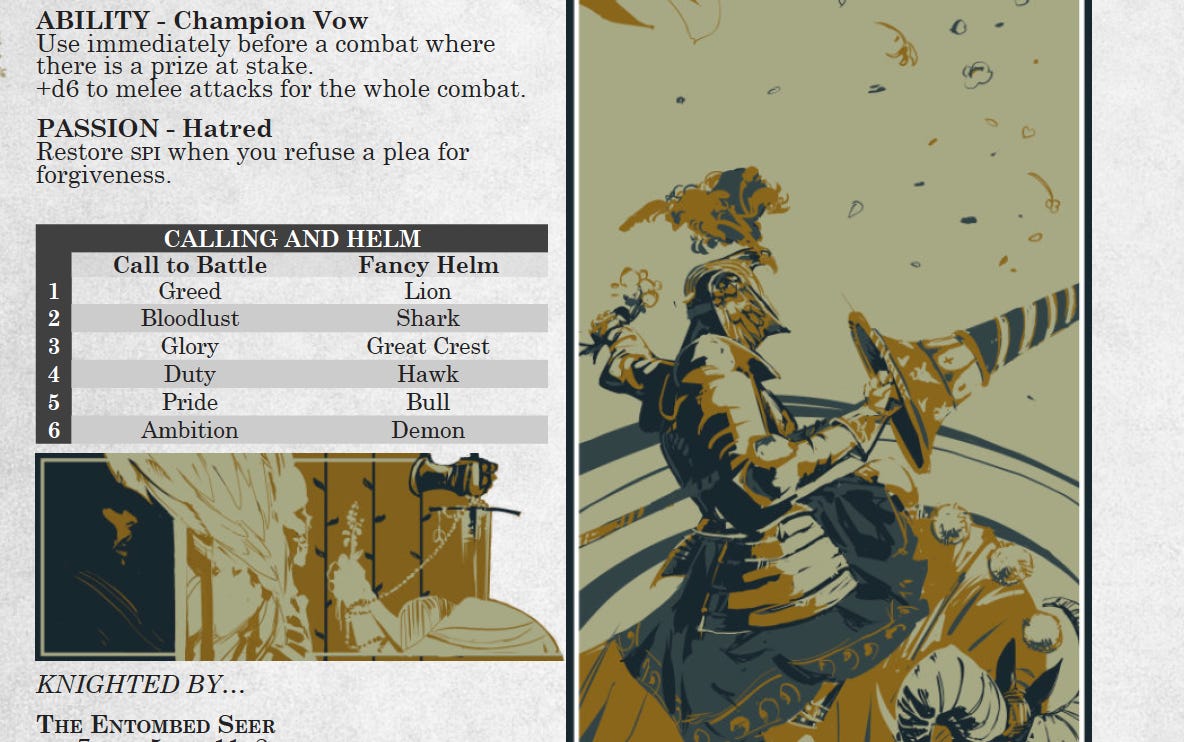
Unbelievably, we're now fast approaching a full year of play! And a full year of time passing within the fiction of the game world too!
So how did we get here?
The Setup
With a flurry of interested people messaging me, I initially capped the game at 8 knights. I figured two groups of 4 starting at different ends of the Realm would work fine, and at the busiest times this proved to be about as much as I could handle without overextending myself.
We ended up with a queue of potential knights and observers (including a couple of names hobby-famous enough to make me feel just a little extra pressure, in a good way!). I set up a “Seer Scrying” role so they could follow everything in the main channels, if they wanted. I had big ideas about expanding the scope, such as adding another Ref and expanding the Realm by another 6x12 hexes to accommodate another group or two of knights, but in the end I’m glad we didn’t go down that road. There’s a real risk of information overload in a PbP that gets too big, and a downstream pressure on the players to keep up which can itself induce a kind of posting-paralysis and reduced engagement over the long term; and an unsustainable workload for the Referee will make for a doomed game.
Players came into the Mythic PbP eager to continue the kind of live text roleplaying experience we’d had with O/U. No sooner had we rolled up knights the players started improvising a scene where all 8 knights were meeting in a “gathering hall” and freely conversing. An amazing feeling! There’s nothing better than engaged players... but now I immediately needed to think on my feet.
With immense gratitude to Yochai Gal’s PbP blogging and the invaluable advice within, I tried to build out the Discord server as something of a middle ground between two styles - spaces for the freeform text RP of O/U alongside the procedural play where game rules and Ref judgement applies, with Mythic’s travel procedure and timekeeping standing in for Cairn’s Dungeon Procedure.
Being real... I created too many channels, the scope was too ambitious.
The idea behind the Free RP channels was to give players an optional space to talk in character to each other without the need for a Ref and without cluttering the main procedural play feed for other players. Inspired by O/U, with threads for each location (one for each Company's camp, one per Holding, and more locations as-encountered), this quickly proved to be redundant with such a low player count and the groups being rarely in the same place. After the initial flurry of freeform text RP that kickstarted play, the procedural hexcrawling and refereed roleplay channels became the focus of player interest.

With hindsight: my resources and rules reference channels should have been merged together, and with everyone on the same page about Discord's markdown text formatting conventions for PbB/LTRP there was no need for a distinct Out Of Character "OOC" channel for each knightly Company within the play category.
Here’s a rough setup I’d recommend:
OOC / Admin
- OOC (out of character) chat
- Rules Reference & Resources (Ref only edit permissions)
The Realm
- Procedural Play Thread (one for each active party)
- Maps & Calendars
- Make a Knight (dice rolling for character creation, etc)
- Character Keeper (forum style, a thread for each knight)
- Public NPC Keeper (forum)
Referee (hidden from players)
- Dice Rolling
- Notes & Drafts for later
- NPC Keeper (forum)
As Yochai advises, I believe you should aim to keep literally everything relevant to play within the server. With these (post-)OSR games there’s no need for a separate character keeper - Discord forum channel will do the job - and a bot like rollem will handle the dice. Maps, images, handouts, rules pages, whatever - throw it all in; let the Discord app be a single pane of glass for engaging with the game, and if players lose track of something it can be found with Ctrl+F or by linking to a post.
The Realm
I generated the Realm using Chris McDowall’s procedure, and drew it up in Procreate using a hacked-apart copy of Chris’s print-and-play hex map PDFs for the Referee. With permission, I put a template version on Itch you can use for yourself.
Roll it up randomly, using the sparks, and don’t be afraid to edit it a little as you work through the Realm Creation Procedure to make it (mostly) make sense. If you need additional advice beyond the scope of the book I'd recommend Elmcat's "Running Mythic Bastionland" guide.
Here’s our player facing map, at the start of our PbP campaign:

Entirely inspired by the Luck Roll podcast (which is a treasure, by the way - you should listen) I fleshed out the Realm while playing a solo campaign within it.
If you don’t want to go that far, just be as thorough as you enjoy being with your Realm creation and the forgiving pace of PbP will give you plenty of time for generating and adding more detail as and when it’s needed.
Mythic is a magical game, I’ve never felt better equipped to improvise within a game setting of my own than I have with my Mythic Realm. Do the prep, use the Spark Tables, make a Ruler’s Council, roll Woes and Dramas for places and Desires and Relationships for NPCs, give your improv that solid blorby foundation, make it feel ready to come alive... and then drop in the Myths and the players and play to see what happens.
Always keep McDowall's "Primacy of Action" in mind: no retcons, if the players have seen or done something in play then it is real and you should never undercut something that has already been established within the fiction - whether that's with Myths and Sparks, or your ongoing prep.
Which leads us to...
Running the Realm
If you’re running more than one group, or if you want to offer the flexibility of players splitting off on their own directions - you already know the saying - strict time records must be kept. I used the calendar by JodTheCod and recommend you do too. I presented that calendar alongside the player facing map in Discord, using a token to indicate which day and time each of the two knightly companies were on, and would update the calendar roughly once a week (real time). With each passing phase of the day, during travel or when time passed inside a Holding, I would post a status update like so:
Dawn, the third Rainsday of Hearths (Winter)
Hex: E2 -- Outside Atheltun, the Tower
no dire weather / fine for travel
Dawn breaks between billowy slates of cloud, casting the mountain in a warm and muggy haze...
[[
please feel free to describe yourself using verminform, you are going to find your way through a series of cracks and crooks in the stonework into the ground floor of the Tower - a hall with an unadorned feast table, with stonework floors covered over with reeds and straw for warmth. All is quiet at the moment aside from the sound of two servants at work in an adjoining kitchen/pantry. Another door presumably leads out to an entrance/exit corridor to the tower's courtyard and/or the stairs up.]]
[[ for
and the other knights, Myghal has given her word that she will order her warband to storm the gate behind you if that's what you want (do consider if that's what you want). The patrols on wall are sparse and infrequent, leaving ample opportunity for placing the explosives at a moment of your choosing. ]]
Weather, sky patterns, flora and fauna and other details would be drawn from Spark Tables and adjusted to feel appropriate to the location or the previously established environmental conditions around the players. You can be flexible in how detailed you get with these elements. The main thing is you keep track of the date and time, and keep the players aware of both the passage of time and the world around them as they knight-about the place. I wanted to hew close to Yochai’s guidance about grounding Cairn PbP in the Dungeon Procedure, adapted for Mythic’s overland hexcrawl.
Having these timekeeping reference points helped me keep the order of events straight, which paid dividends for me as the two player groups started to cross over locations that their counterparts had recently visited, and took actions which would affect the situation for the other group. Especially as time would tend to move in fits and starts - one group would spend a week of real time play in one place and one day, while another raced ahead in time, only for the latter group to hit a period of slow play or detailed roleplay and the first group would suddenly overtake.
With two groups in the Realm I occasionally bent the rules of the Wilderness Roll to avoid one group taking the next Omen from a Myth the other group was intently focused on - swapping in an Omen from an otherwise dormant Myth or the nearest Myth. I didn’t always do this, and for one Myth in particular it made sense for both groups to each separately experience a couple of the same early Omens from the one Myth. With PbP being a slow burn form of roleplaying I wanted to put my thumb on the scales in this one matter, to prioritise the threads the players were actively trying to follow and to keep the Myths coherent for the two groups. This shouldn't matter in a game with one active Company of knights.
More on the Myths later.
Otherwise, we essentially played the game rules-as-written - with a generous portion of verbose (and delightfully fun) text-based roleplay scenes sprinkled throughout.
With Chris McDowall’s spark tables, the 72 Myths, your Realm prep, d72 page footer prompts and the streamlined dice mechanics for Saves and combat, you wont find many games that equip a Referee for PbP play better than Mythic Bastionland. Any time you get stuck you look to the book and your notes and you’ll be good to go.
Sometimes we’d go a week without the players rolling dice but I think that was in line with McDowall’s guidance for when and why players should roll.
For the combat, when it comes up, you’ll want to make sure the players know the rhythm of when they can use each of their knightly Feats, and don’t shy away from reminding them if it’s been a while since the last time they drew steel. The attack dice are brutal, ideally you want it to be their choice and not a lapse of memory leading them to pass on a Feat opportunity. Repeated links to the Specifics of Combat page were always appreciated by my players.
I have been extremely fortunate with the players who joined the game. Each and every one of them has been superb. That's something you can't account for in your prep or with the best of intentions: sometimes, as a Referee, it's better to be lucky than be good.
the Myths vs the Players
Did I mention the Primacy of Action already? Nothing is more important.
Sometimes a Myth will play out in the sequence of six "Omens" laid out in the book, this typically happens if the players do not take action which would change the course of events. That's not a failing on their part, especially as some Myths are more cryptic and less obviously interactive than others - you'll still get good scenes out of your knights encountering the Omens.
Sometimes you will need to improvise and substantially change the Myths when players take action which intervenes with the sequence of Omens. This is good! Established action takes primacy over the book. Let it happen, lean in! Reward creative engagement with the fiction.

Here's a couple of Myths that my players changed significantly:
The Colossus
- An elderly sculpter toils away, carving a great statue into a cliff face. He boasts that the statue is based on him in his youthful prime. He knows he is dying and longs for immortality.
The first Omen was encountered as normal, but the players took such a keen interest in the sculpter that I improvised some additional backstory - that he was well travelled, including a particular love for a village (as yet undiscovered by the players) located 4 hexes to the east, and the group spent the night camping at the base of statue with him.
The group later returned through this hex several days later with the intent of catching up to their new sculpter friend. Knowing the other Omens, I played up his ill health setting in and showed that the Colossus was essentially finished. Again, they elected to camp there. The wilderness roll for the night phase was a 3 (Omen from nearest Myth)...
- Across the Realm the earth shakes and rumbles as the Colossus awakes.
Incredible! So I set a scene in the evening where the sculpter passes away, cared for by a couple of the knights, and then when all were asleep that knight the Company suddenly found themselves at the epicentre of the earth-shaking awakening of the Colossus!
This is where the Myth goes entirely off its rails.
The knights elect to pursue to the Colossus across the Realm, galloping on their horses as fast as they can to keep up. You can't force the Omens as-written to make sense when players intervene in this way, so instead the Colossus marches to the village I mentioned earlier, chased by the knights, and rather than have any further Wilderness rolls we arrive at a composite final scene assembled with elements taken from the other Omens. The knights managed to distract and lead the Colossus out of the village, saving lives, and then bore witness as a version of the 6th and final Omen plays out - the enormous statue of their friend crumbling to rock in the woods before them, finally laid to rest.
The Bull
Confession time: I'd already messed with this Myth a little before the knights encountered it. I decided that rumour of a couple of Myths should be seeded at the Kindlemass festival where everyone was gathered after Advancing Time, and one of those rumours would be lifted from Omen 2 of The Bull: its blessings taking effect, in the southern part of the Realm.
Soon after, our knights encountered Omen 1:
- Leaf-covered acolytes parade a newly born green bull, declaring a blessing on the Realm. They are taking him to a secret location for safekeeping.
They were extremely keen to question the acolytes, and to see if there was any curses associated with the Bull's blessings. They were determined to follow after the acolytes and find out where they were going. One of our knights convinced the acolytes she was an eager and genuine potential new convert, and so we split the party (PbP is very good for this), and so the Myth went entirely off the rails from Omen 1.
I decided the secret location would be the farm where the Bull was born, and that it made sense to be located on the Myth Hex. To put a face on the acolytes I used the "Person: Zealous student ~ Name: Foxter" prompts from the bottom of the Bull page spread as the basis of an NPC for the knight to befriend. The knight was led there, initiated into the acolytes, and she was surprised to learn that there was no malice or ill intent - it was an improvised religion cobbled together from half-remembered folk stories of previous appearances of the Bull, and all the acolytes wished for was to protect their totemic creature and its blessings.
The Company reunited, sought guidance from a Seer on this and other matters, and then decided to immediately gallop back to the farm at the Myth hex. As the Travel rules state:
Ending a phase in the Hex containing a Myth always reveals its next Omen without making a Wilderness Roll. When possible, the Knights also get the drop on the Omen.
Past action by the knights had effectively covered Omens 1 and 2 from this Myth, so we go to 3...
- On a dusty trail, the Bull lies dead. A scream is heard in the distance, two children running to say that they saw the Knights standing over the corpse. The Blessings of the Bull are lost.
Ah. Hmm.
I wanted to respect "the Knights get the drop on the Omen" and everything they had done to this point, and the established fiction of the farm. So I presented a composite situation, taking elements from all the remaining Omens and statblocks of the Myth: the knights are galloping toward the farm, they can see 7 winged fiends descending upon the mostly helpless acolytes and the Bull, Solas the Leaf-Clad Guard was present, and the knights had a desperate and slim chance to intervene before the Bull was slain.
Following some heroic deeds (such as our knight with the worst stats throwing himself directly in the path of several fiends) and a desperate, grim battle at the farm where several acolytes were killed and a knight suffered a mortal wound, the knights won! The fiends defeated, and the Bull and the acolytes are an ongoing presence in the Realm (for now, at least).
This is not at all how the Myth is "supposed to go" but when your knights are coming up with clever plans, consulting with Seers, and actively intervening with the course of the Myths? As Chris McDowall states:
remember this, the most important thing: Past action taken by the players supersedes content generated by prompts or rules. Their deeds are reality. Remember the core of giving players information, honouring their choices, and describing the impact of their actions.
The Lesson
I hope those examples illustrate that everything you need to support improvisation (and follow the Primacy of Action) is already in the Mythic Bastionland book and within your prepared Realm.
The beauty of PbP is you have time on your side. If you need to consult the book or your prep, or roll some sparks, or double check the Refereeing guide, you can. Think about what should happen next, then write it up - you've got this.
General PbP Advice and Comments
Keep up the posting. It’s fine to be waiting on players over a weekend or for a day or two, and sometimes you’ll need to nudge people by @ tagging them, but you can and should keep everyone in the loop and engaged with OOC chat. Try not to be the reason play is stopped for longer than 24 hours, not without letting players know why.
Further to that, you shouldn't need to ping an entire group more than once or twice a day. Don't flood notifications and make the game un-fun. Direct replies to queries or actions by a single player are fine.
Aim to spend 15 minutes to an hour a day on the game, and more often than not it should be closer to the 15 minutes mark. I sometimes go long on scene setting (it’s a mythic realm! It’s fun to write!) but you can save yourself a lot of typing by laying out a situation in plain and clear OOC writing. If you’re presenting an open-ended OSR-ish environmental problem (or challenging foe) the clarity of your writing is more important than evocative prose.
One of the beauties of running a PbP on Discord is search. Your play is your notes and it’s all searchable, and potentially reusable in the event a group of knights is the second to arrive in a location.
I recommend using a markdown text editor for writing the more verbose parts of play, and you should get familiar with Discord’s markdown formatting. I like IA Writer on iOS/iPad and Ghostwriter on desktop; others swear by Obsidian. Compose, copy, paste. Main thing: don’t write long and carefully formatted posts in Discord if you can avoid it.
Set expectations with your players about the commitment and participation that’s required to sustain a PbP early on, but more important than that is reassuring them that their contributions don’t need to be overly elaborate or especially demanding; sometimes all you need from them is acknowledgement they're happy for play to continue. Yakamo’s blogging about her experience with Play by Post gives some invaluable insights into the challenges felt on the player-side experience of PbP and it’s something I try to be mindful of as we play.
If you find that engagement is waning, I found that a "break" for a couple of weeks then Advancing Time (as per the rules) was a great way to get the game restarted. Adding new players helps to keep things fresh also.