a mechanic out of context
For context: this post is inspired by a question posed in an excellent podcast episode recorded by Thomas Manuel for Rascal News, in which he reads and responds to the Warden's Operation Manual for Mothership. You should listen to the full episode because it's great; Thomas is extremely insightful and asks probing questions of the text.
For me the most thought provoking question posed by Thomas was regarding Mothership's d100 Stat Check, and the desire for greater clarity on what exactly the Stat Check represents.
To be crystal clear: this is not a takedown or callout aimed at Thomas. I thoroughly enjoyed the podcast episode. This is about bridging different styles of game design and play culture expectations, so there's a risk that many of you reading will find the points I make to be redundant or obvious (and if that's the case for you I apologise).
(An actual callout: I don't believe the popular dndtuber who called Mothership "CoC in space" has read the game, and if he did I don't believe he played it, or if he did play it must have been without reading the text.)
Thomas asks:
Do you think there is a line where advice becomes so critical to the vision of play that it should be incorporated into the rules design at some point? What do you think about my statement that the core mechanic of the game is "underdesigned"?
So... yeah, I felt compelled to push back against the notion of the Mothership d100 Stat Check being "underdesigned".
The main assertion I'm making here is that "GM advice" is System, just as much as the capital-R rules... at least for the kinds of roleplaying games which most interest me, the kinds which centre the conversation between participants (players, referee/facilitator, whatever).
In these kinds of game (whichever label you put on them, be it "OSR" or "post-OSR" or "PbtA" or "storygame"), the way that the facilitator or referee communicates with players and vice-versa is the context in which any given rule or dice mechanic functions. The subject and content and tone of conversation - the framing of scenes, the description of a room, the questions and clarifications, the statement of intent, the description of action, and the shared memory of what was said before - is the ground upon which the dice resolution stands, and the "GM advice", or the "Principles", or however it's framed in a given text, is there to guide and shape the style of conversation appropriate to a given game.
To strip a rule from its context is to render it “underdesigned”.
a mechanic out of context
For those who are unfamiliar: Mothership uses a binary d100 (0 to 99) 'roll under' dice system for resolving Stat Checks and Saves. When a player-character is proactive they are using the Stat Check, when they are reactive they are rolling a Save. Rolling a "double" (e.g. 33 or 99) makes for a critical success or failure (depending on whether you rolled below or above your Stat number).
On the surface this looks an awful lot like the Call of Cthulhu d100 system. So far so Trad. It's just a Skill Check, right? Pass/fail. Some modifiers, some advantage/disadvantage if you care to use those things, etc. Did player do the thing, accomplish the task? Y/N. Not much to hang a game off, right...?
Wrong!
"If you fail, the situation gets worse and you gain 1 Stress” ~Player’s Survival Guide section 28.1 'How do I Attack?' (note: it doesn't say "you miss the target")
There isn't a lot of (hard) rules in Mothership, and most of what's there is about how badly your character can get hurt, or an ever-increasing risk of a loss of agency via Stress accumulation and Panic Checks. Most of the game, most of the text, is (soft) advice to players and the Warden/referee/facilitator.
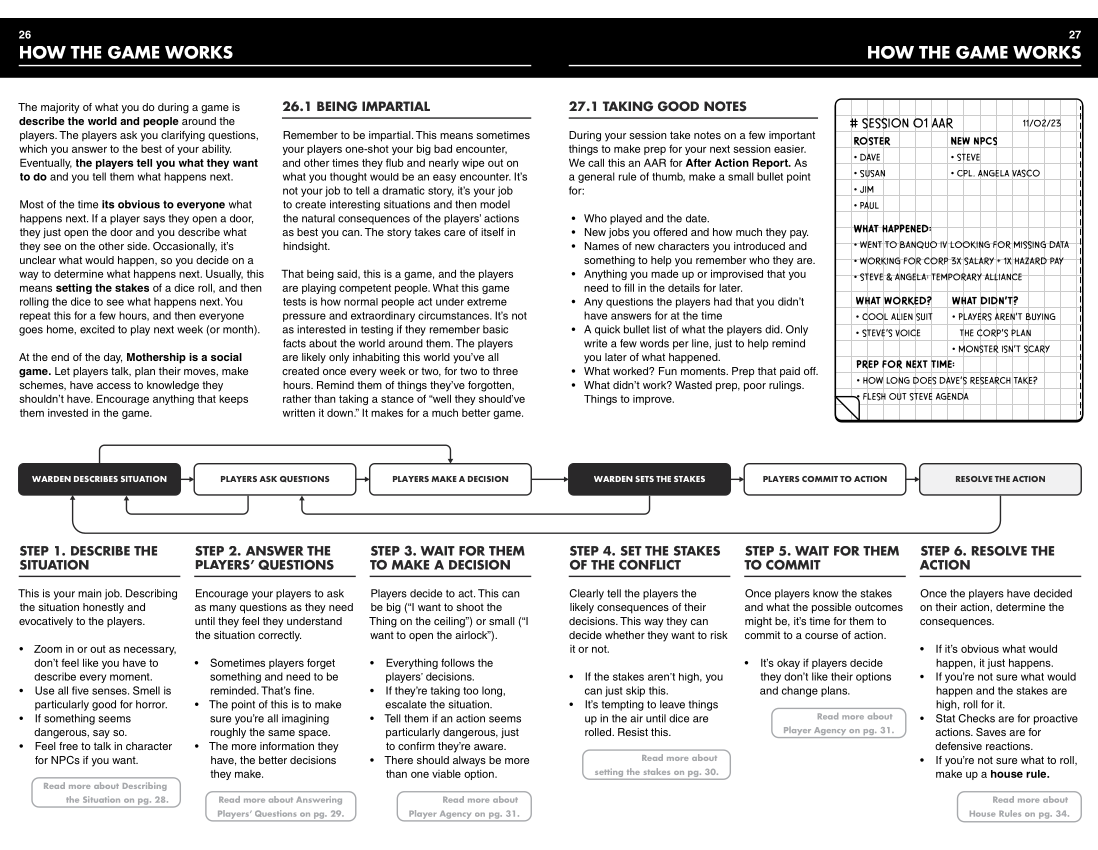
The Warden’s Operation Manual talks at length about establishing what kinds of things could go wrong for the players through conversation before dice are ever rolled in Mothership, underpinned by an assumption that the player-characters are highly competent individuals facing the worst day(s) of their lives. I don't need to repeat it all here - the point is that the conversation in which a situation is described and questioned, how stakes are set, how players are given agency to decide and commit before rolling, and how to interpret the results of the roll in relation to everything previously established is present in the text.
So the way that I understand the Stat Check is not as a binary "does this player succeed at a task?" roll, it is an oracle you look to for determining "does the situation get worse in this moment? (and by how much?)". If the situation reasonably shouldn't get worse you don't pick up the dice, and the player-character simply does what they intended to do. Not so Trad now, eh?
In play I'm yet to see anyone who didn't intuit the difference between failing with a "42 over 35" and failing with a "78 over 35". There's also the 4 step gradation of outcome in critical fail (things go as badly as possible) to fail (gets worse) to success (doesn't get worse) to critical success (the situation actually improves, maybe?). So I'm inclined to agree with Sean McCoy's statement - that the d100 mechanic gives us plenty of scope for interpretation - over Thomas’ reading of the Stat Check.

but should it be Rules?
The comparison that was drawn against the Stat Check is the Action Roll d6 dice pool mechanic from Blades in the Dark, which is commonly understood to deliver a range of “fail” (1-3), “mixed success”/“success at cost” (4-5) and “success” (6) results, with the number of dice in the pool determined by the value of the character's relevant skill/attribute.
The real difference between Mothership and Blades here is that instead of contextualising the core dice resolution with advice, the latter places the Action Roll in a set of procedural rules about "Position" (how vulnerable the player-character may be to negative consequences of their action) and "Effect" (how impactful the action might be); both of which are derived from and negotiated in the conversation between player(s) and referee/facilitator/GM about fictional situation and player intent. The text is firm about this - when a player triggers an Action Roll the “Position and Effect” discussion is supposed to be integral to the procedure, and has mechanical outcomes such as adjusted Harm levels or "ticks" on the game's various Clocks.
I think that if you remove the practice of establishing “Position and Effect” and clear situational stakes from the Action Roll you're left with something similarly hollow as the d100 Stat Check might appear, taken out of context. Additionally, the mixed success (and the frequency they occur in the d6 dice pool) could potentially feel like an arbitrary imposition of consequences for the player if the Blades GM doesn't correctly use P&E to shape the Action Roll and instead frames it more like a CoC or 5e skill check.
What happens if we flip the question, and ask: is design-through-rules less likely to result in the misuse of System by a referee/GM/Warden/etc than design-through-advice?
One might argue that the re-framing of the Action Roll as a Threat Roll in Deep Cuts is a nudge from designer John Harper to push Blades GMs away from this kind of misunderstanding... and, if we wanted to get really spicy, perhaps we could argue that the framing of "Position and Effect" as Rules is therefore no more inherently effective at supporting the Action Role than the advice given by the WOM regarding the framing and interpretation of the d100 Stat Check...
So you can probably guess where I'm going with this?
No - the advice doesn't need to be rules, it just needs to be taught well.
These two games present two different ways of arriving at a similar place... but I would argue that the Mothership method requires greater trust in the reader as referee/facilitator on the part of the game designer, and perhaps delivers a more fluid and less stilted conversational experience at the table. For me, at least.
...or maybe that's a skill (check) issue.